
You invested in a website. You publish content. Maybe you even hired someone for SEO.
Yet your traffic is stagnant, leads are inconsistent, and Google feels… silent.
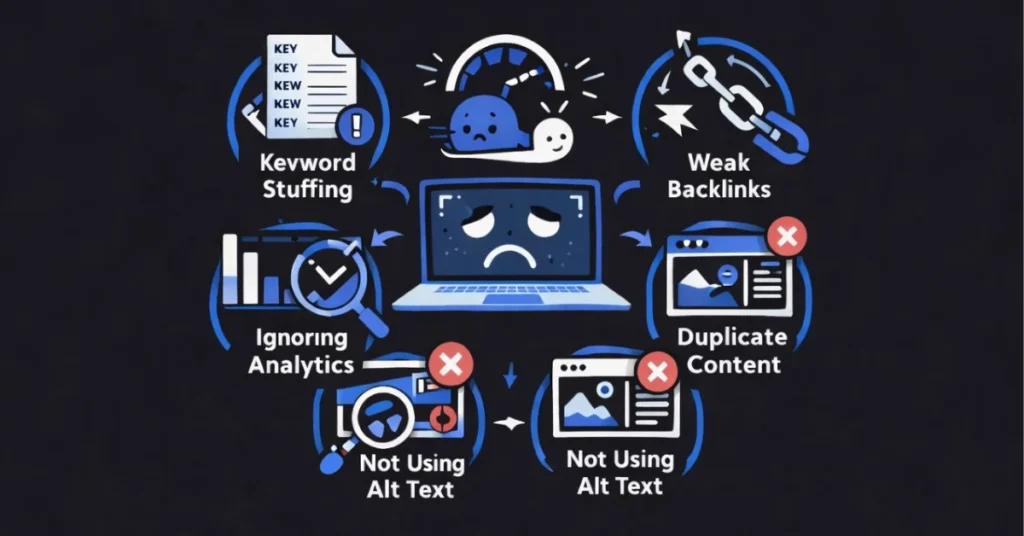
Here’s the uncomfortable truth: SEO doesn’t usually fail because you didn’t try it fails because of small but costly mistakes. These mistakes quietly block your growth while competitors move ahead.In this blog, I’ll break down the most common SEO mistakes that silently kill website traffic, explain why they matter, and show you how to fix them whether you’re a startup founder or running a large business.
1. Ignoring Search Intent (The Biggest SEO Killer)
Many businesses focus on what they want to rank for, not what users actually want.
For example:
- A service page trying to rank with blog-style content
- An informational keyword pointing to a sales page
Google’s priority is simple: serve the best answer for the user’s intent.
Why does this hurt traffic?
If your content doesn’t match intent, Google won’t rank it—even if your keywords are perfect.
Fix it
Before creating content, ask:
- Is the user looking to learn, compare, or buy?
- Are top-ranking pages blogs, landing pages, or product pages?
Match your content format to what’s already winning.
2. Keyword Stuffing Instead of Keyword Strategy
SEO has evolved, but many websites are stuck in 2012.
Repeating the same keyword unnaturally across headings and paragraphs doesn’t boost rankings it hurts them.
Why does this hurt traffic?
- Google understands context, not repetition
- Keyword stuffing damages readability and user trust
- High bounce rates signal poor content quality
Fix it
Use:
- One primary keyword
- Supporting keywords and natural variations
- Clear, human-friendly language
Write for people first, search engines second.
3. Weak or Duplicate Content Across Pages
Thin content is one of the fastest ways to lose organic visibility.
This includes:
- 300-word blogs with no depth
- Copy-pasted service pages
- Location pages with only city names changed
Why does this hurt traffic?
Google prioritizes value and originality. If your content doesn’t add something new, it won’t rank.
Fix it
- Create in-depth content that solves real problems
- Answer follow-up questions users might ask
- Make every page serve a clear purpose
Quality beats quantity every single time.
4. Neglecting Technical SEO Basics
You can have great content, but if Google can’t crawl or understand your site, it won’t matter.
Common technical mistakes include:
- Slow page speed
- Broken links
- Poor mobile experience
- Indexing issues
Why does this hurt traffic?
Search engines favor sites that provide a smooth user experience. Technical issues send negative signals.
Fix it
Regularly audit:
- Page speed (especially mobile)
- Core Web Vitals
- Crawl errors in Search Console
- HTTPS and clean URL structure
Technical SEO isn’t optional it’s foundational.
5. Not Optimizing for Mobile Users
More than half of all searches happen on mobile. Yet many business websites are still designed desktop-first.
Why does this hurt traffic?
Google uses mobile-first indexing, meaning it ranks your mobile site—not your desktop version.
If your mobile experience is poor:
- Rankings drop
- Bounce rates increase
- Conversions suffer
Fix it
- Use responsive design
- Ensure readable text without zooming
- Optimize buttons and navigation for touch
A fast, clean mobile site is no longer a “nice to have.”
6. Forgetting Internal Linking
Internal links guide both users and search engines through your website. Many businesses underuse them or ignore them completely.
Why does this hurt traffic?
- Important pages don’t get authority
- Users leave without exploring
- Google struggles to understand page relationships
Fix it
- Link related blogs to service pages
- Use descriptive anchor text
- Build clear content clusters
Think of internal links as roads connecting your website’s value.
7. No Clear SEO Goal or Measurement
SEO without tracking is like marketing blindfolded.
Many businesses:
- Don’t track keyword performance
- Ignore Search Console data
- Focus only on traffic, not conversions
Why does this hurt traffic?
You can’t improve what you don’t measure. SEO requires continuous optimisation.
Fix it
Track:
- Organic traffic trends
- Keyword rankings
- Click-through rates
- Leads or conversions from organic search
SEO is not a one-time task; it’s an ongoing process.
8. Expecting Instant Results (Then Giving Up)
SEO is a long-term investment, not a quick campaign.
One of the biggest mistakes businesses make is quitting too early.
Why does this hurt traffic?
SEO builds authority over time. Stopping midway resets momentum and wastes effort.
Fix it
- Commit to consistent content and optimization
- Review progress monthly, not weekly
- Focus on steady growth, not overnight success
The businesses winning SEO today are the ones who stayed patient yesterday.
Final Thoughts
SEO doesn’t fail because it’s complicated it fails because it’s misunderstood.
By avoiding these common mistakes and focusing on intent, quality, technical health, and consistency, you create a strong foundation that compounds over time.
Whether you’re a small business owner trying to get discovered locally or a large business aiming for national visibility, SEO done right becomes your most reliable traffic source.
The question isn’t “Does SEO work?”
It’s “Are you doing it the right way?”